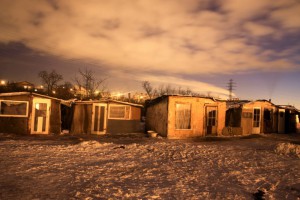
The European Court of Human Rights has ruled that Poland violated the rights of Roma families who were forcibly evicted from the settlement on Paprotna Street in Wrocław. The demolition of their homes in 2015 was carried out in violation of the European Convention on Human Rights.
The Roma people lost their homes without warning. On July 22, 2015, the city of Wrocław demolished a small settlement where several Roma families had been living since 2009. The residents were not informed about the demolition – they left for work in the morning and returned to find only rubble. They lost not only their homes but also their documents, medications, and all their belongings.
„It was a matter for the whole city.”
The eviction of the Roma people sparked a strong public reaction. “Residents, artists, and academics got involved. Fundraisers were organized, housing was sought, and children were helped with their education. This showed that society is capable of responding to injustice,” says Agata Ferenc, an ethnologist and cultural mediator from Nomada.
The city had the possibility to act differently.
Under public pressure, Wrocław implemented support measures for Roma families—some individuals received assistance with residency legalization and access to housing. One family managed to obtain social housing.
What’s next?
The ECHR ruling is an important precedent. It shows that human rights apply to everyone and cannot be violated with impunity. It is also a signal to local authorities – migration policy must take into account the real needs of minorities and protect them from homelessness.
„It was a matter for the whole city.”
A conversation with Agata Ferenc about the ruling of the European Court of Human Rights, the solidarity of the residents, and changes in migration policy.
How did you feel when you learned about the verdict?
Agata Ferenc: It’s hard to talk about surprise because this process lasted almost a decade. We had known for a year that a decision would be made, but when it finally happened, I mostly thought about those people – what does this mean for them? How can we explain it to them? How can we tell them about these complicated legal procedures when the system has treated them as invisible their whole lives?
It was a very long process, but for them, what was crucial was that someone stood up for them, that their story was noticed. That’s what my role was about – being a bridge between the Roma community and a system that didn’t understand their realities, and vice versa.
Is 5,000 euros in compensation a fair reparation?
It is a symbolic compensation. The valuation of the losses was entirely different, but this money can improve their lives – help with medical treatment or renovating a house in Romania.
This forced eviction came at a great cost – for these people, it was the loss of everything: their homes, documents, memories, and security. To understand this, you have to see their life from their perspective.
What happened to the Roma after the eviction?
They moved to the area on Kamieńskiego Street, but it was another temporary solution – no access to running water, no sanitation, no support of any kind. The authorities did not offer them housing, psychological help, or anything.
Among them were children, elderly people, and individuals with disabilities. And they all suddenly found themselves in a situation of absolute helplessness. It was a test for the social system and its institutions – a test that, at that moment, was largely failed.
What was the reaction of the Wrocław community?
And here we come to what was most remarkable in all of this – solidarity. Because although the institutions failed, the people rose to the challenge. It wasn’t the issue of just one organization or a few activists. It was the issue of the entire city.
I remember how the cultural and academic community, activist groups, artists, and performers got involved. It wasn’t just a legal battle – it was an attempt to loudly say, “These are our neighbors, residents of Wrocław. We cannot turn our backs on them.“
What did that mean in practice?
These were very concrete actions. People organized grassroots support – they helped find jobs, assisted with paperwork, and held classes for children. When the institutions didn’t act, the community took matters into their own hands.
I remember that even ordinary, everyday things were of immense importance – someone would take the children to the pool, someone else would help with their studies. Suddenly, this makeshift camp became a place where people came with a desire to offer support, not just out of curiosity or fear.
And it changed not only the situation of the Roma, but also the residents of Wrocław themselves. People began to look at migrants, refugees, and those living on the margins in a different way. It was a real lesson in integration.
Did the response of the authorities change due to this social pressure?
Yes. At first, officials didn’t know how to communicate with the Roma. I remember the first meetings, when their faces seemed to say, “How do we deal with them?” because they had no experience. We kept repeating, “Just sit down and talk.“
Over time, the situation began to change. The Roma were gradually treated as full participants in the discussions. Their representatives traveled to Warsaw, talked to ministries, and participated in meetings. It was a huge step forward.
Has the city learned a lesson from this?
Yes, and that is one of the greatest achievements of this story. Because it began with a tragedy – the forced eviction. But it ended with the development of mechanisms that later helped other migrants and refugees as well.
Today, Wrocław is developing a local migration policy. The fact that there is now talk of the need for migrant integration is largely due to those events. Back then, we learned that integration is not only the responsibility of the authorities but a shared responsibility of the residents.
What does this ruling tell us about the future of migration policy?
It is a reminder that human rights cannot be violated without consequences. Strasbourg sets precedents – this ruling is not just about the Roma from Paprotna, but a signal to all of Europe. If we want to build an open society, we must learn from such cases.
We now have a chance not to treat this story as a closed chapter, but as a lesson. The ruling in Strasbourg is a good moment to look back and see what we can learn from this history. Because if we don’t remember, in a few years we might make the same mistakes.
Is there anything that gives you hope for the future?
Yes. Looking at the past 10 years, I see a change. The Roma, and especially Romani women, now have a stronger voice in Poland, more organizations are working with them, and support mechanisms have been created. What happened in Wrocław was one of the first such cases in Poland and had an impact on subsequent actions.
Besides that, there are still people who want to take action, who refuse to accept exclusion. That is the hope. Human rights are important, and it’s worth fighting for them, especially now, when we are seeing their erosion on a global level. It is up to us to ensure their observance in our immediate surroundings.